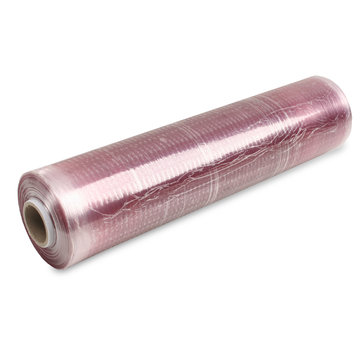
Paper and film products for the food service and food processing industries help with covering, separating, packaging, preparing, and processing food. At Nette, you’ll find food wrap made from PE and PVC, aluminum foil, parchment paper, covering paper, cellophane, and pre-cut sheets made from various materials. Choose the material, size, and type that best suit the food, temperature, and operational needs in restaurants, bakeries, butcher shops, catering services, and commercial kitchens.
Whether for covering, wrapping, separating, baking, or preparing food, papers and films serve a variety of purposes in the professional food industry. That is why this category includes a range of materials and product types, whose properties should be specifically tailored to their intended use.
The product range includes, among other items, PE and PVC food wrap, aluminum foil, baking parchment, cream-covering paper, cellophane, and pre-cut sheets made of HDPE, PP, and OPP. To select the right product, you can go directly to our sections on food wrap & dispensers, cut sheets & cover papers, and baking parchment paper.
Food wrap is used to cover, wrap, and safely store suitable foods. Adhesion, stretchability, and permissible food contact conditions vary depending on the material.
PE and PVC food wrap should therefore not be selected based solely on roll width. The type of food, temperature, contact time, and the documented conditions of use are also critical factors.
You can find all available rolls, Wrapmaster models, and matching dispensers under Food Wrap & Dispensers.
Aluminum foil is used in professional kitchens for covering, wrapping, and—depending on the type—for certain cooking or grilling applications. In addition to standard rolls, extra-strong varieties, dispenser cartons, and foil for dispenser systems are available.
Which applications are permitted depends on the specific product and the food item. Product-specific instructions should be followed, particularly when handling highly acidic or salty foods.
Baking parchment aids in baking and in the handling of doughs and baked goods. Depending on the product, it is available in sheets or rolls and can be used on baking sheets or other designated baking surfaces.
It is particularly practical for bakeries, pastry shops, and baking stores that frequently handle different tray sizes or production volumes. You can find additional products for the baked goods sector under Bakery Supplies.
Pre-cut films and papers can be placed directly between, on top of, or around food. This eliminates the need to cut rolls to size during the workflow.
The “Pre-cut Sheets & Covering Papers” category includes, among other items, pre-cut sheets made of HDPE, PP, OPP, and cellophane, as well as various types of covering papers. The appropriate type depends on the type of food, its fat and moisture content, temperature, and contact time.
Cellophane, also known as cellulose hydrate, offers a transparent surface and is used for various packaging and presentation applications. In addition to roll stock, our product range also includes pre-cut cellophane options.
The specific suitability for food use and the permissible conditions of use should be verified based on the individual product.
In butcher shops and meat markets, films and pre-cut sheets are used, for example, to separate, cover, or package suitable meat, sausage, and deli products.
Especially with fatty or moist foods, only materials confirmed as suitable for these types of food should be used. You can find additional products for the counter, processing, and sales under “Butchery Supplies.”
Bakeries and pastry shops primarily need baking parchment, covering papers, and suitable films for production, temporary storage, and sales. The appropriate type depends, among other things, on baking temperature, food type, and workflow.
You can find additional packaging and supplies for baked goods in our Bakery Supplies section.
Restaurants, cafeterias, commercial kitchens, and catering businesses require various films for mise-en-place, temporary storage, covering, and food preparation. Roll width and length can be just as critical as the material and food contact requirements.
You can find additional items for professional kitchens and takeout sales under “Foodservice Supplies & Packaging” as well as in our “Catering Supplies” section.
The selection should not be based solely on the material name. The specific intended use is what matters:
The product-specific information for each item always takes precedence.
Many products in this category are intended for direct food contact. However, the permitted food types and conditions of use vary significantly. Depending on the product, dry, moist, acidic, or fatty foods, as well as specific temperature and contact time ranges, may be approved.
Dispensers and roll holders, on the other hand, are used for processing or dispensing films and, by design, do not come into contact with the food themselves. Therefore, the entire category should not be broadly labeled as “food-safe” or “tasteless.”
The recyclability of paper, plastic, aluminum, or composite products depends on their material composition, potential contamination, and the available collection, sorting, and recycling infrastructure. Therefore, the category should not be advertised across the board with claims such as “recyclable,” “environmentally friendly,” or “sustainable.”
When selecting products, specific characteristics such as material, food contact suitability, temperature range, format, and intended use are more meaningful.
The product range includes, among other items, PE and PVC food wrap, aluminum foil, baking parchment, cover papers, cellophane, and die-cut sheets made of HDPE, PP, and OPP. Matching film and Wrapmaster dispensers are also available.
That depends on the specific material and product. For food wrap and cut sheets, the specifically approved food types, temperatures, and contact times must be observed. The product information for the respective version is decisive.
No. This category includes various products as well as dispensers. Therefore, statements regarding food contact should always refer to the specific product.
PE and PVC are different plastics with different material and application properties. PVC film is often characterized by good adhesion and elasticity. However, the permissible food contact conditions may vary.
This must be assessed on a product-by-product basis. Not every plastic wrap is intended for contact with all types of fats. For certain products, specific high-fat foods may be permitted, while direct contact with pure oil, for example, is prohibited.
Baking parchment is used as a barrier layer between baked goods and the designated baking surface. It can help baked goods release from the surface and is available in sheets or rolls, depending on the product.
Film cut sheets are sheets of film that have already been cut to a specific size. This allows them to be used directly for separating, covering, or packaging suitable foods without first having to be cut from a roll.
PP stands for polypropylene, OPP for oriented polypropylene, and HDPE for high-density polyethylene. The materials differ in terms of mechanical properties, transparency, and potential applications. Specific food contact suitability depends on the individual product.
There is no blanket answer for the entire category. Recyclability depends, among other things, on the material, structure, possible composite layers, and the available collection, sorting, and recycling processes.
Depending on the application, options include, for example, die-cut films, cling film, or covering paper. For meat, sausage, and deli products, particular attention should be paid to fat content, moisture, temperature, and contact time.
For bakeries and pastry shops, baking parchment, cream-covering paper, and suitable films for preparation and temporary storage are particularly relevant. The selection depends on the specific food item and production step.
If film is used regularly, a dispenser system can facilitate controlled unrolling and cutting. Compatibility of rolls should be verified based on the specific dispenser and the intended film series.